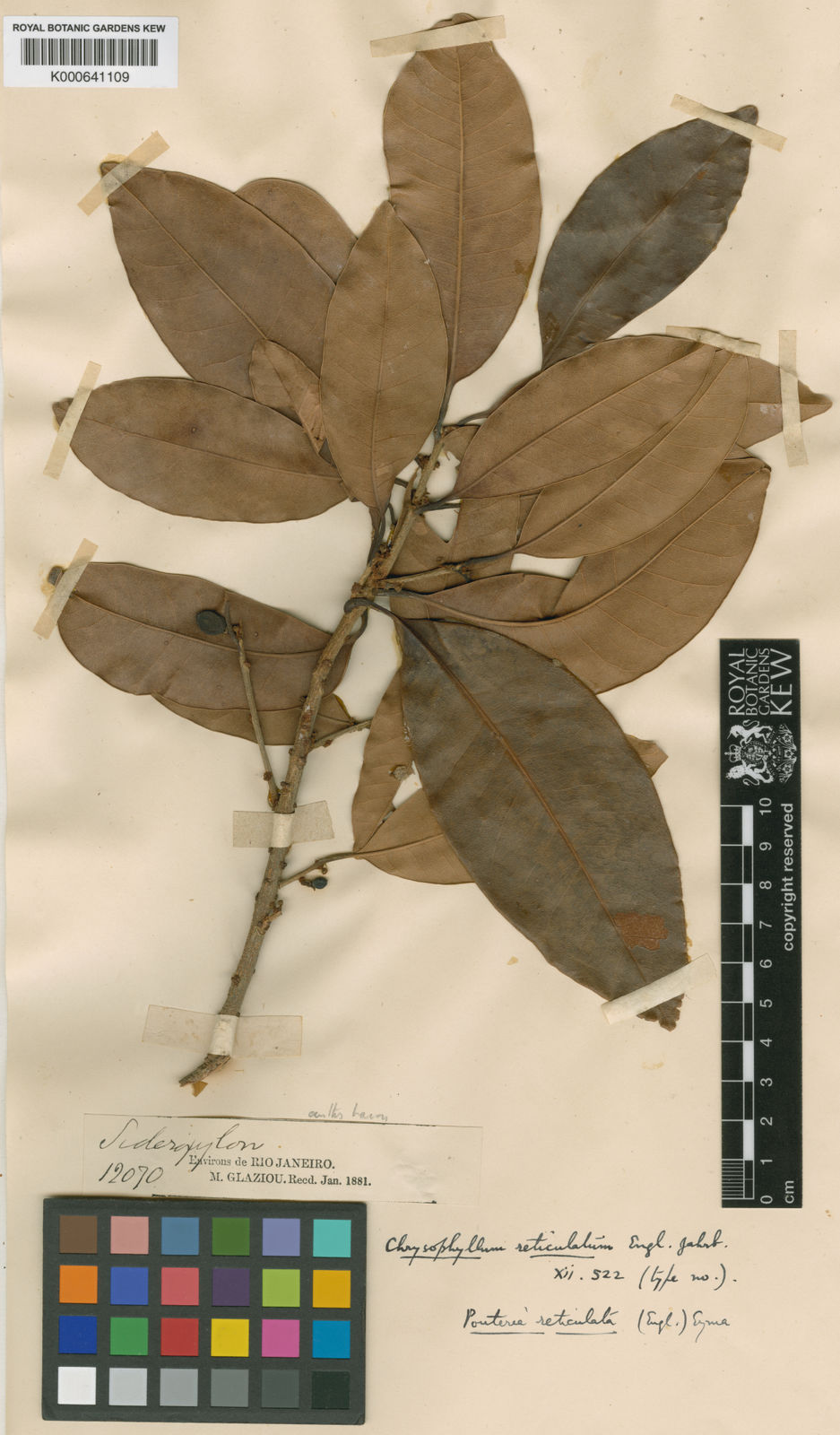
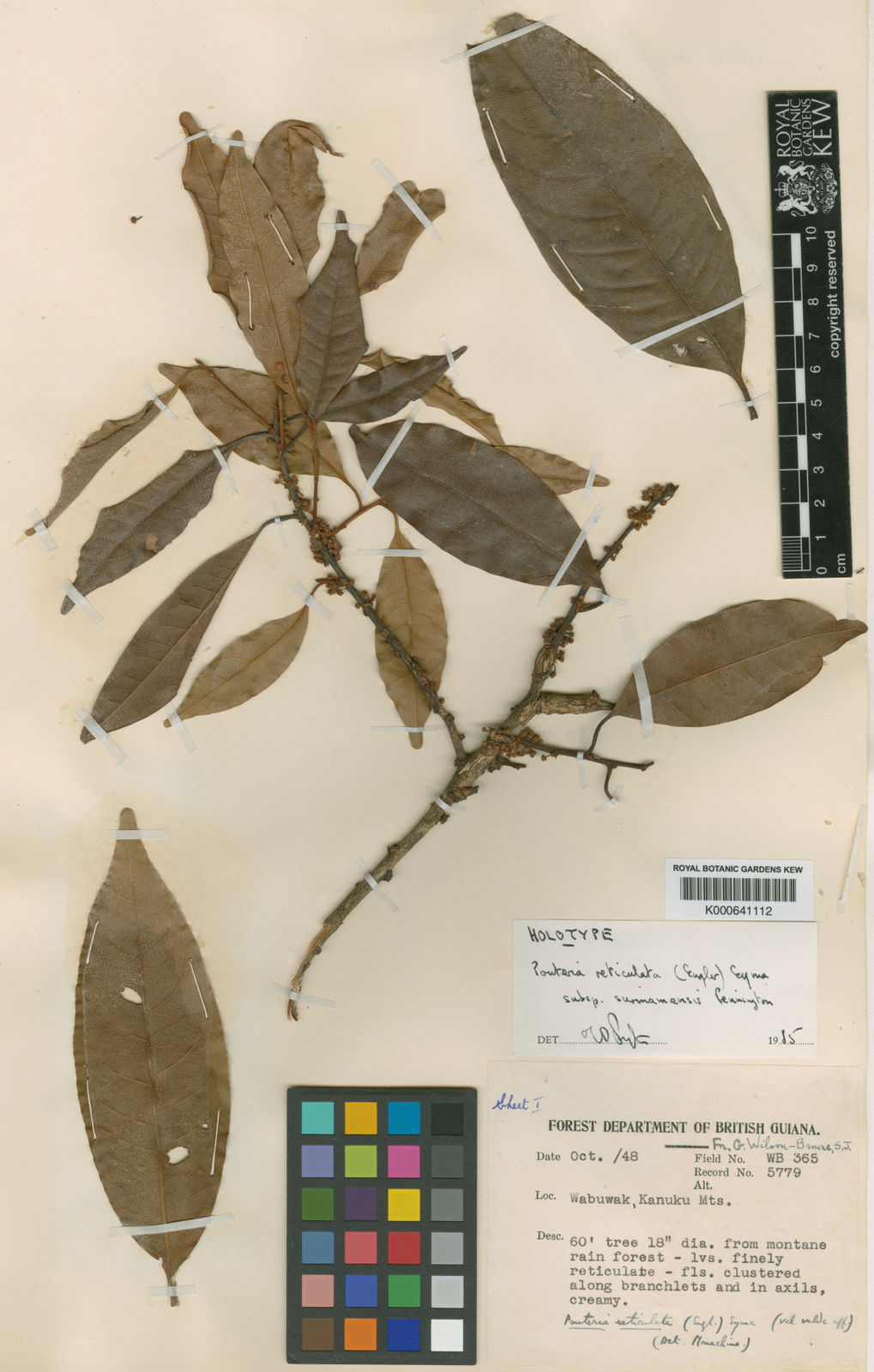
Pouteria reticulata (Engl.) Eyma

First published in Recueil Trav. Bot. Néerl. 33: 183 (1936)
This species is accepted
The native range of this species is S. Mexico to S. Tropical America. It is a tree and grows primarily in the wet tropical biome. It is used for food.

Distribution

Native to:

Belize, Bolivia, Brazil North, Brazil Northeast, Brazil Southeast, Brazil West-Central, Colombia, Costa Rica, Ecuador, French Guiana, Guatemala, Guyana, Honduras, Mexico Gulf, Mexico Southeast, Mexico Southwest, Nicaragua, Panamá, Peru, Suriname, Venezuela

Synonyms

Homotypic Synonyms

Heterotypic Synonyms

Classification

Kew's Tree of Life Explorer

Discover the flowering plant tree of life and the genomic data used to build it.

View the Tree of Life
PAFTOL

POWO follows these authorities in accepting this name:

  • Alves-Arauja, A. & Alves, M. (2010). Flora da Usina São José, Igarassu, Pernambuco: Sapotaceae. Rodriguésia; Revista do Instituto de Biologia Vegetal, Jardim Botânico e Estaçao Biologica do Itatiaya 61: 303-318.
  • Alves-Araújo, A., Swenson, U. & Alves, M. (2014). A taxonomic survey of Pouteria (Sapotaceae) from the northern portion of the Atlantic rainforest of Brazil. Systematic Botany 39: 915-938.
  • Davidse, G. & al. (eds.) (2009). Flora Mesoamericana 4(1): 1-855. Universidad Nacional Autónoma de México, México, D.F.
  • Garcia-Mendoza, A.J. & Meave, J.A. (eds.) (2012). Diversidad florística de Oaxaca: de musgos a angiospermas (colecciones y listas de especies), ed. 2: 1-351. Instituto de Biología, Universidad Nacional Autónoma de México.
  • Govaerts, R., Frodin, D.G. & Pennington, D. (2001 publ. 2002). World Checklist and Bibliography of Sapotaceae: 1-364. The Board of Trustees of the Royal Botanic Gardens, Kew.
  • Hokche, O., Berry, P.E. & Huber, O. (eds.) (2008). Nuevo Catálogo de la Flora Vascular de Venezuela: 1-859. Fundación Instituto Botánico de Venezuela.
  • Molino, J.-F., Sabatier, D., Grenand, P., Engel, J., Frame, D., Delprete, P.G., Fleury, M., Odonne, G., Davy, D., Lucas, E.J. & Martin, C.A. (2022). An annotated checklist of the tree species of French Guiana, including vernacular nomenclature. Adansonia, sér. 3, 44: 345-903.
  • Oliveira-Filho, A.T. (2006). Catálogo das Árvores nativas de Minas Gerais: 1-423. Editora UFLA, Lavas, Brasil.
  • Villaseñor, J.L. (2016). Checklist of the native vascular plants of Mexico. Revista Mexicana de Biodiversidad 87: 559-902.

Catálogo de Plantas y Líquenes de Colombia

  • Bernal, R., Gradstein, S.R. & Celis, M. (eds.). 2015. Catálogo de plantas y líquenes de Colombia. Instituto de Ciencias Naturales, Universidad Nacional de Colombia, Bogotá. http://catalogoplantasdecolombia.unal.edu.co

Kew Backbone Distributions

  • Garcia-Mendoza, A.J. & Meave, J.A. (eds.) (2012). Diversidad florística de Oaxaca: de musgos a angiospermas (colecciones y listas de especies), ed. 2: 1-351. Instituto de Biología, Universidad Nacional Autónoma de México.
  • Molino, J.-F., Sabatier, D., Grenand, P., Engel, J., Frame, D., Delprete, P.G., Fleury, M., Odonne, G., Davy, D., Lucas, E.J. & Martin, C.A. (2022). An annotated checklist of the tree species of French Guiana, including vernacular nomenclature. Adansonia, sér. 3, 44: 345-903.

Useful Plants and Fungi of Colombia

  • Bernal, R., Gradstein, S.R., & Celis, M. (eds.). (2020). Catálogo de Plantas y Líquenes de Colombia. v1.1. Universidad Nacional de Colombia. Dataset/Checklist. https://doi.org/10.15472/7avdhn
  • Castañeda, R.R. (1991). Frutas silvestres de Colombia. Instituto Colombiano de Cultura Hispánica.
  • Diazgranados et al. (2021). Catalogue of plants of Colombia. Useful Plants and Fungi of Colombia project. In prep.
  • FPI (2021). Food Plants International. https://fms.cmsvr.com/fmi/webd/Food_Plants_World?homeurl=https://foodplantsinternational.com/plants/
  • GBIF.org (2021). GBIF species matching tool. https://www.gbif.org/tools/species-lookup
  • IUCN (2021). The IUCN Red List of Threatened Species. Version 2021-2. https://www.iucnredlist.org.
  • Instituto de Investigación de Recursos Biológicos Alexander von Humboldt (2015). Identificación de las plantas útiles como Productos Forestales No Maderables del Bosque seco-Tropical en tres ventanas del Caribe colombiano. 1386 registros, aportados por: Garcia, H. (Contacto del Recurso), López Camacho, R. (Creador del recurso), Sarmiento Bernal, C. (Proveedor del metadatos). Espitia Palenci, L. (Autor), Gallego, B. (Punto de contacto), Aguilar Cano, J. (Curador), Mendoza, H. (Curador). Versión 2.0. http://i2d.humboldt.org.co/ceiba/resource.do?r=rrbb_bst-caribe_plantae_2015

Sources

  • Angiosperm Extinction Risk Predictions v1

    • Angiosperm Threat Predictions
    • http://creativecommons.org/licenses/by/4.0
  • Catálogo de Plantas y Líquenes de Colombia

    • http://creativecommons.org/licenses/by-nc-sa/3.0
  • Herbarium Catalogue Specimens

    • Digital Image © Board of Trustees, RBG Kew http://creativecommons.org/licenses/by/3.0/
  • IUCN Categories

    • IUCN Red List of Threatened Species
    • http://creativecommons.org/licenses/by-nc-sa/3.0
  • Kew Backbone Distributions

    • The International Plant Names Index and World Checklist of Vascular Plants 2026. Published on the Internet at http://www.ipni.org and https://powo.science.kew.org/
    • © Copyright 2023 World Checklist of Vascular Plants. http://creativecommons.org/licenses/by/3.0
  • Kew Names and Taxonomic Backbone

    • The International Plant Names Index and World Checklist of Vascular Plants 2026. Published on the Internet at http://www.ipni.org and https://powo.science.kew.org/
    • © Copyright 2023 International Plant Names Index and World Checklist of Vascular Plants. http://creativecommons.org/licenses/by/3.0
  • Useful Plants and Fungi of Colombia

    • http://creativecommons.org/licenses/by-nc-sa/3.0