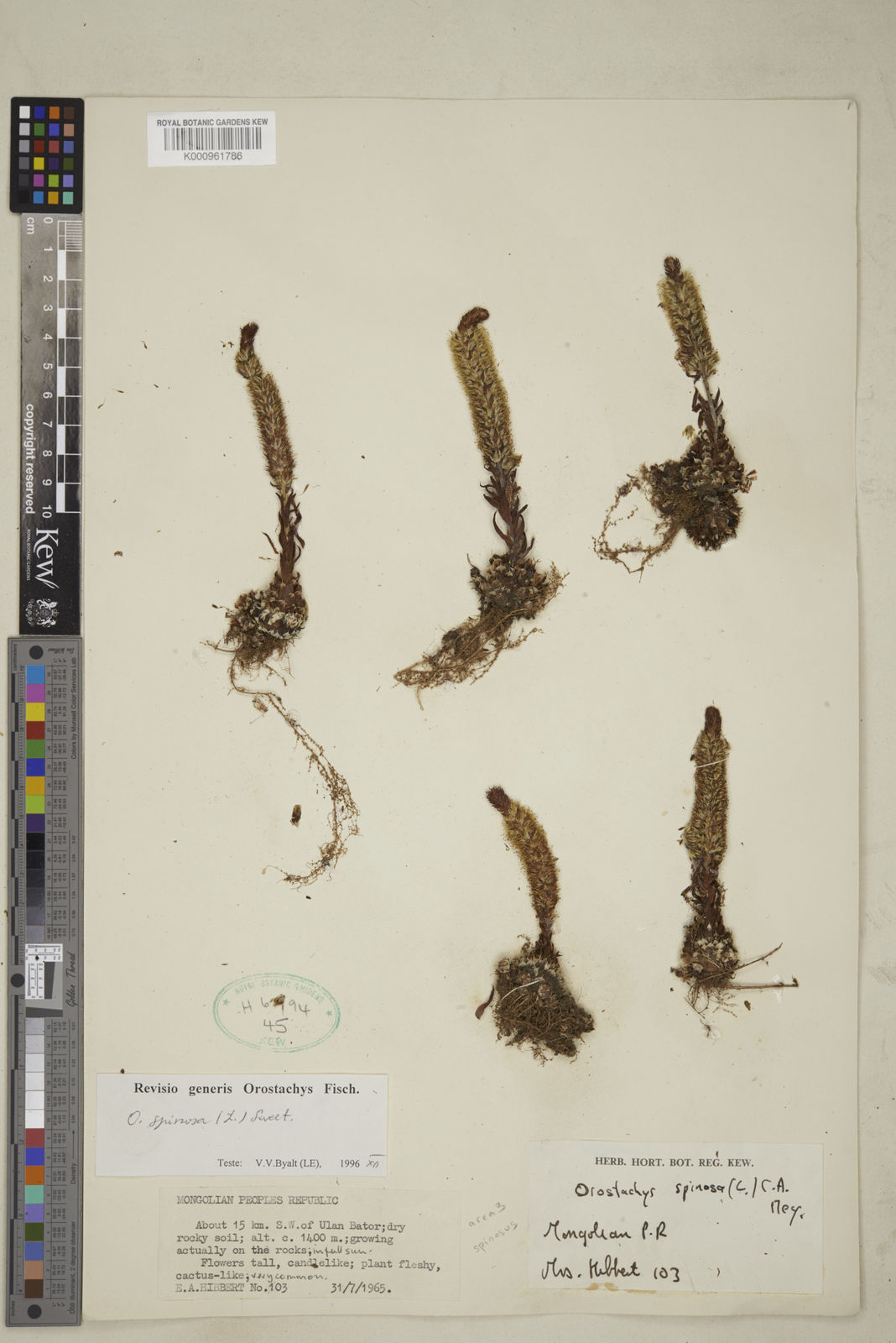
Orostachys spinosa (L.) Sweet

First published in Hort. Brit., ed. 2: 225 (1830)
This species is accepted
The native range of this species is E. European Russia to Russian Far East and Korea. It is a succulent perennial and grows primarily in the subalpine or subarctic biome.

Distribution

Native to:

Altay, Amur, Buryatiya, China North-Central, Chita, East European Russia, Inner Mongolia, Irkutsk, Kazakhstan, Khabarovsk, Krasnoyarsk, Magadan, Manchuria, Mongolia, Primorye, Tibet, Tuva, West Siberia, Xinjiang, Yakutiya

Synonyms

Homotypic Synonyms

Heterotypic Synonyms

Classification

Kew's Tree of Life Explorer

Discover the flowering plant tree of life and the genomic data used to build it.

View the Tree of Life
PAFTOL

POWO follows these authorities in accepting this name:

  • Abdulina, S.A. (1999). Spisok Sosudistykn Rastenii Kazakhstana: 1-187. Academy of Sciences, Almaty, Kazakhstan.
  • Charkevicz, S.S. (ed.) (1995). Plantae Vasculares Orientalis Extremi Sovietici 7: 1-394. Nauka, Leningrad.
  • Jalas, J., Suominen, J., Lampinen, R. & Kurtto, A.(eds.) (1999). Atlas Florae Europaeae. Distribution of vascular plants in Europe 12: 1-250.
  • Kozhevnikov, A.E., Kozhevnikov, Z.V., Kwak, M. & Lee, B.Y. (2019). Illustrated flora of the Primorsky Territory, Russian Far East: 1-1124. National institute of biological resources.
  • Malyschev, L.I. & Peschkova, G.A. (eds.) (2004). Flora of Siberia 7: 1-318. Scientific Publishers, Inc., Enfield, Plymouth.
  • Nikolin, E.G. (2013). Conspectus florae resource rezervat "Suntar-Hayata" republic Sakha (Yakutia). Rastitel'nyj mir Aziatskoj Rossii 1(11): 47-57.
  • Nikolin, E.G. (2020). Opredelitel' vysshikh rasteniy Yakutii: 1-895. Moskva : Tovarishchestvo Nauchnykh Izdaniy KMK Novosibirsk "Nauka".
  • Wu, Z. & Raven, P.H. (eds.) (2001). Flora of China 8: 1-506. Science Press (Beijing) & Missouri Botanical Garden Press (St. Louis).
  • Zhao, Y.Z., Zhao, L.Q. & Rui, C. (eds.) (2019). Flora Intramongolica, edition 3, 2: 1-579. Typis Intramongolicae popularis, Huhhot.

Kew Backbone Distributions

  • Abdulina, S.A. (1999). Spisok Sosudistykn Rastenii Kazakhstana: 1-187. Academy of Sciences, Almaty, Kazakhstan.
  • Charkevicz, S.S. (ed.) (1995). Plantae Vasculares Orientalis Extremi Sovietici 7: 1-394. Nauka, Leningrad.
  • Jalas, J., Suominen, J., Lampinen, R. & Kurtto, A.(eds.) (1999). Atlas Florae Europaeae. Distribution of vascular plants in Europe 12: 1-250.
  • Malyschev, L.I. & Peschkova, G.A. (eds.) (2004). Flora of Siberia 7: 1-318. Scientific Publishers, Inc., Enfield, Plymouth.
  • Nikolin, E.G. (2013). Conspectus florae resource rezervat "Suntar-Hayata" republic Sakha (Yakutia). Rastitel'nyj mir Aziatskoj Rossii 1(11): 47-57.
  • Wu, Z. & Raven, P.H. (eds.) (2001). Flora of China 8: 1-506. Science Press (Beijing) & Missouri Botanical Garden Press (St. Louis).

Sources

  • Angiosperm Extinction Risk Predictions v1

    • Angiosperm Threat Predictions
    • http://creativecommons.org/licenses/by/4.0
  • Herbarium Catalogue Specimens

    • Digital Image © Board of Trustees, RBG Kew http://creativecommons.org/licenses/by/3.0/
  • Kew Backbone Distributions

    • The International Plant Names Index and World Checklist of Vascular Plants 2026. Published on the Internet at http://www.ipni.org and https://powo.science.kew.org/
    • © Copyright 2023 World Checklist of Vascular Plants. http://creativecommons.org/licenses/by/3.0
  • Kew Names and Taxonomic Backbone

    • The International Plant Names Index and World Checklist of Vascular Plants 2026. Published on the Internet at http://www.ipni.org and https://powo.science.kew.org/
    • © Copyright 2023 International Plant Names Index and World Checklist of Vascular Plants. http://creativecommons.org/licenses/by/3.0