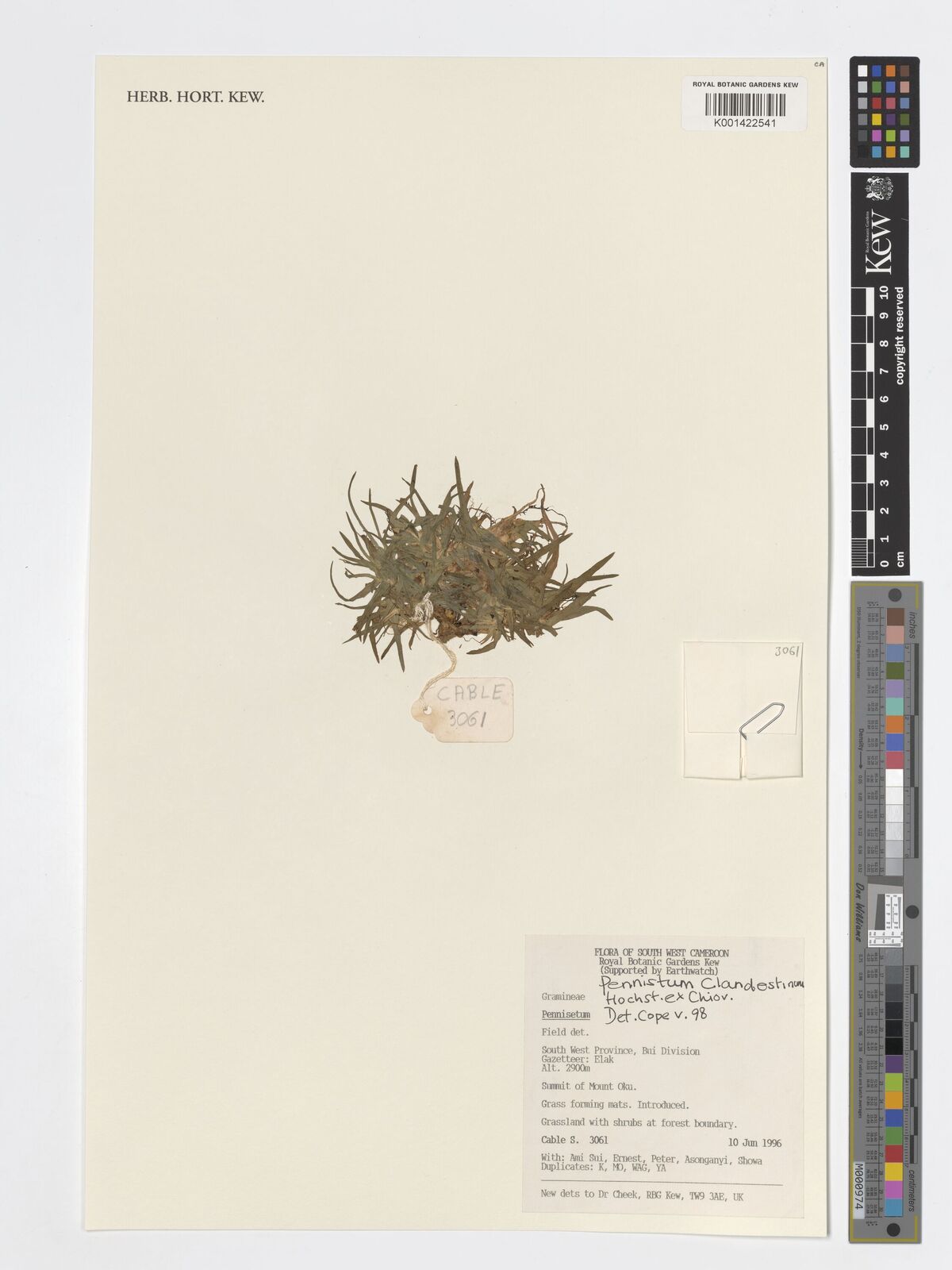
Dichanthelium clandestinum (L.) Gould

First published in Brittonia 26: 59 (1974)
This species is accepted
The native range of this species is E. Canada to Central & E. U.S.A. It is a perennial and grows primarily in the temperate biome.

Descriptions

Extinction risk predictions for the world's flowering plants to support their conservation (2024). Bachman, S.P., Brown, M.J.M., Leão, T.C.C., Lughadha, E.N., Walker, B.E. https://nph.onlinelibrary.wiley.com/doi/full/10.1111/nph.19592

Conservation
Predicted extinction risk: not threatened. Confidence: confident
[AERP]

Morphology General Habit
Perennial; caespitose. Rhizomes short. Culms 40-100 cm long. Culm-internodes antrorsely scabrous; distally pubescent to hispid. Culm-nodes glabrous, or pubescent. Lateral branches fastigiate. Leaves basal and cauline; heterophyllous with a basal winter rosette. Leaf-sheaths hispid; with tubercle-based hairs. Ligule a fringe of hairs, or absent; 0-1 mm long. Collar pubescent. Leaf-blade base cordate. Leaf-blades spreading, or reflexed; lanceolate; 10-28 cm long; 10-30 mm wide. Leaf-blade surface scabrous; rough on both sides; glabrous. Leaf-blade margins ciliate; hairy at base.
Morphology Reproductive morphology Inflorescences
Inflorescence a panicle; terminal and axillary. Panicle open; elliptic; 9-16 cm long. Spikelets solitary. Fertile spikelets pedicelled.
Morphology Reproductive morphology Inflorescences Spikelets
Spikelets comprising 1 basal sterile florets; 1 fertile florets; without rhachilla extension. Spikelets elliptic; with obtuse base; dorsally compressed; subacute; 2.7-3.1 mm long; falling entire.
Fertile
Spikelets comprising 1 basal sterile florets; 1 fertile florets; without rhachilla extension. Spikelets elliptic; with obtuse base; dorsally compressed; subacute; 2.7-3.1 mm long; falling entire.
Morphology Reproductive morphology Inflorescences Bracts Glume
Glumes dissimilar; reaching apex of florets; thinner than fertile lemma. Lower glume ovate; 0.33 length of spikelet; membranous; without keels; 1 -veined. Lower glume lateral veins absent. Lower glume apex obtuse. Upper glume oblong; 1 length of spikelet; membranous; without keels; 7 -veined. Upper glume surface glabrous, or puberulous. Upper glume apex obtuse.
Morphology Reproductive morphology Flowers Florets
Basal sterile florets barren; with palea. Lemma of lower sterile floret similar to upper glume; oblong; 1 length of spikelet; membranous; 7 -veined; glabrous, or puberulous; obtuse. Fertile lemma oblong; dorsally compressed; 2.7-3.1 mm long; indurate; without keel. Lemma margins involute. Lemma apex obtuse. Palea involute; indurate.
Morphology Reproductive morphology Fruits
Caryopsis with adherent pericarp.
Distribution
North America: eastern Canada, north-central USA, northeast USA, south-central USA, and southeast USA.
Reference
Paniceae. Gr Texas 1994.
[GB]

Sources

  • Angiosperm Extinction Risk Predictions v1

    • Angiosperm Threat Predictions
    • http://creativecommons.org/licenses/by/4.0
  • GrassBase - The Online World Grass Flora

    • Clayton, W.D., Vorontsova, M.S., Harman, K.T. and Williamson, H. (2006 onwards). GrassBase - The Online World Grass Flora.
    • http://creativecommons.org/licenses/by-nc-sa/3.0
  • Herbarium Catalogue Specimens

    • Digital Image © Board of Trustees, RBG Kew http://creativecommons.org/licenses/by/3.0/
  • Kew Backbone Distributions

    • The International Plant Names Index and World Checklist of Vascular Plants 2026. Published on the Internet at http://www.ipni.org and https://powo.science.kew.org/
    • © Copyright 2023 World Checklist of Vascular Plants. http://creativecommons.org/licenses/by/3.0
  • Kew Names and Taxonomic Backbone

    • The International Plant Names Index and World Checklist of Vascular Plants 2026. Published on the Internet at http://www.ipni.org and https://powo.science.kew.org/
    • © Copyright 2023 International Plant Names Index and World Checklist of Vascular Plants. http://creativecommons.org/licenses/by/3.0