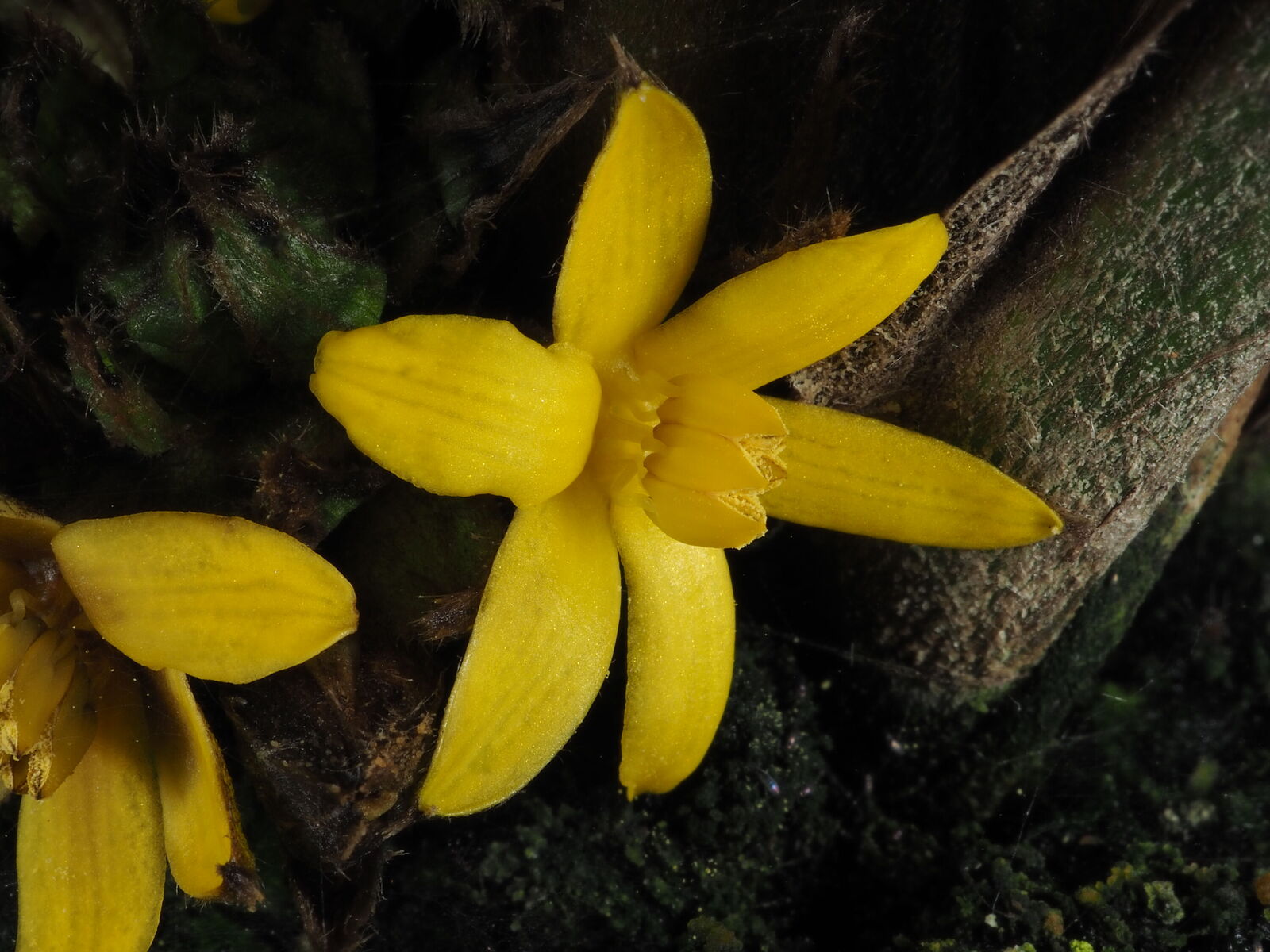
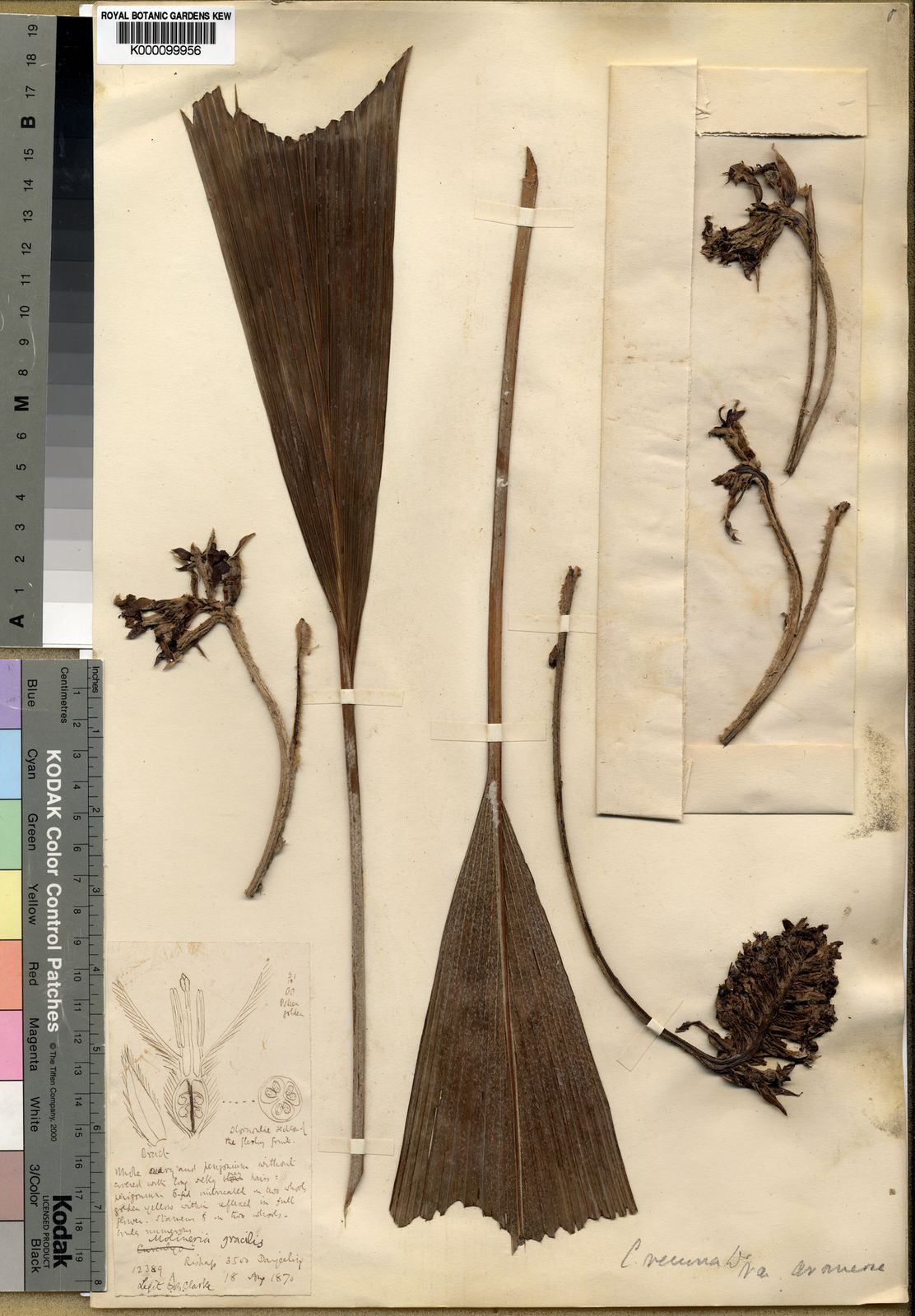
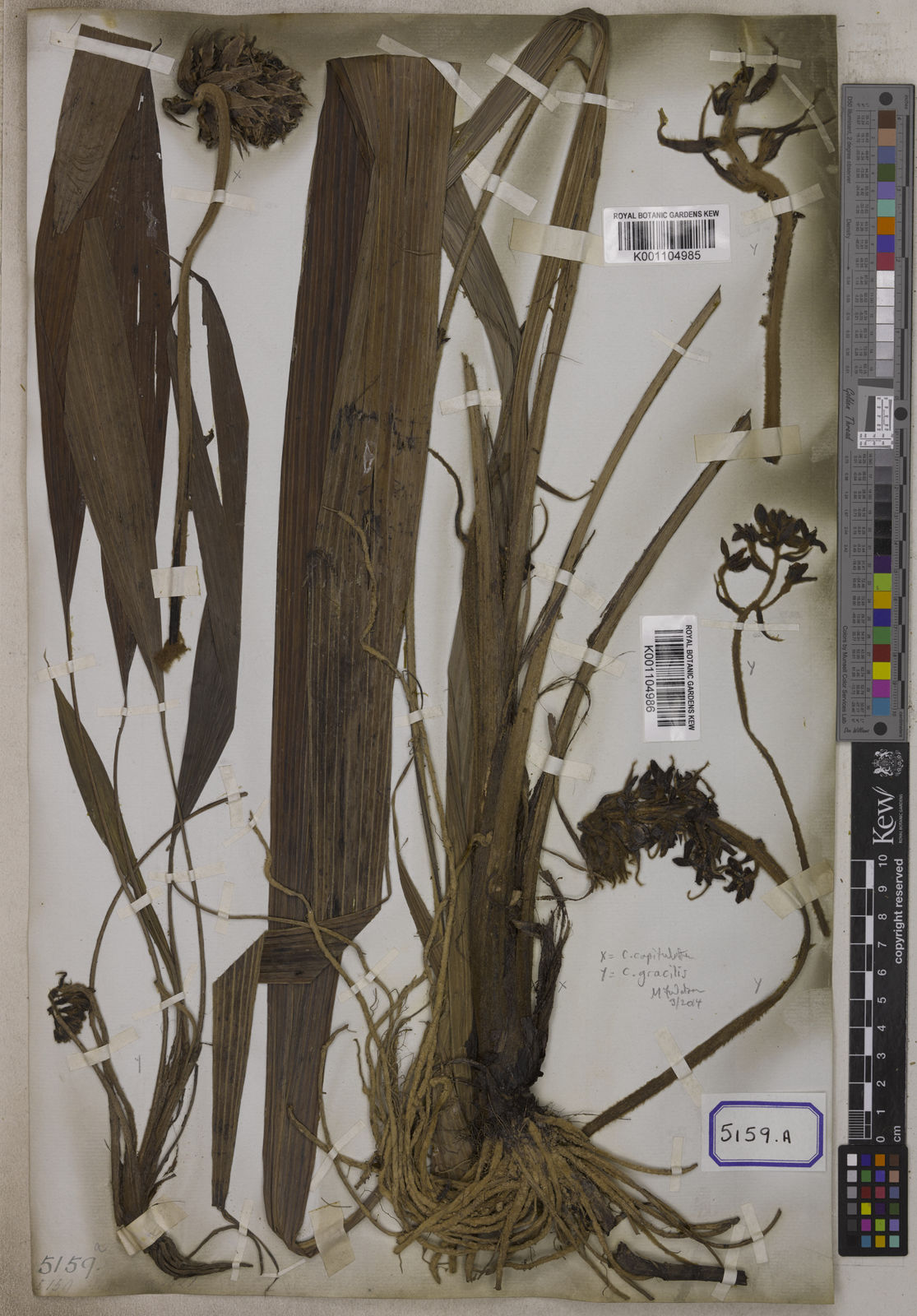
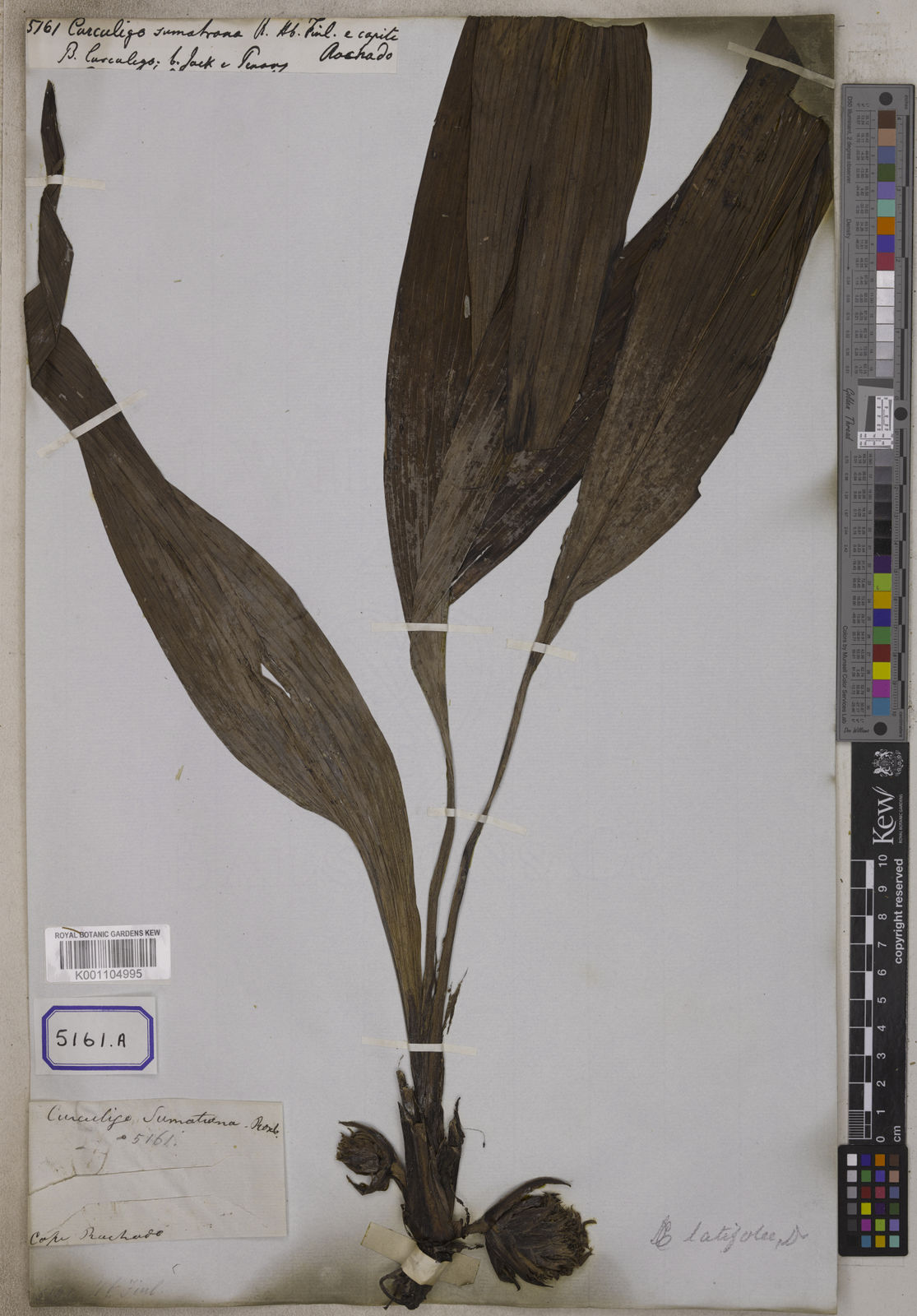
Curculigo capitulata (Lour.) Kuntze

First published in Revis. Gen. Pl. 2: 703 (1891)
This species is accepted
The native range of this species is Nepal to S. China and NE. Queensland. It is a tuberous geophyte and grows primarily in the wet tropical biome. It is has environmental uses and social uses, as a medicine and for food.

Distribution

Native to:

Assam, Bangladesh, China South-Central, China Southeast, East Himalaya, Hainan, Jawa, Laos, Lesser Sunda Is., Malaya, Maluku, Myanmar, Nepal, New Guinea, Nicobar Is., Philippines, Queensland, Solomon Is., Sulawesi, Sumatera, Taiwan, Thailand, Tibet, Vietnam

Introduced into:

Argentina Northeast, Colombia, Cuba, Dominican Republic, El Salvador, Guatemala, Honduras, India, Leeward Is., Madagascar, Mauritius, Mexico Central, Mexico Northeast, Mexico Southeast, Mexico Southwest, New Caledonia, Nicaragua, Puerto Rico, Réunion, Sri Lanka, Trinidad-Tobago, Windward Is.

Synonyms

Homotypic Synonyms

Heterotypic Synonyms

Classification

Kew's Tree of Life Explorer

Discover the flowering plant tree of life and the genomic data used to build it.

View the Tree of Life
PAFTOL

POWO follows these authorities in accepting this name:

  • Zhengyi, W. & Raven, P.H. (eds.) (2000). Flora of China 24: 1-431. Missouri Botanical Garden Press, St. Louis.

An alternative taxonomy had been proposed by the following authorities:

  • Davidse, G. & al. (eds.) (1994). Flora Mesoamericana 6: 1-543. Universidad Nacional Autónoma de México, México, D.F. [Cited as Molineria capitulata.]
  • Govaerts, R. (1999). World Checklist of Seed Plants 3(1, 2a & 2b): 1-1532. MIM, Deurne. [Cited as Molineria capitulata.]
  • Nelson Sutherland, C.H. (2008). Catálogo de las plantes vasculares de Honduras. Espermatofitas: 1-1576. SERNA/Guaymuras, Tegucigalpa, Honduras. [Cited as Molineria capitulata.]

Kew Backbone Distributions

  • Acevedo-Rodríguez, P. & Strong, M.T. (2005). Monocotyledons and Gymnosperms of Puerto Rico and the Virgin Islands. Contributions from the United States National Herbarium 52: 1-415.
  • Acevedo-Rodríguez, P. & Strong, M.T. (2012). Catalogue of seed plants of the West Indies. Smithsonian Contributions to Botany 98: 1-1192.
  • Baksh-Comeau, Y., Maharaj, S.S., Adams, C.D., Harris, S.A., Filer, D.L. & Hawthorne, W.D. (2016). An annotated checklist of the vascular plants of Trinidad and Tobago with analysis of vegetation types and botanical 'hotspots'. Phytotaxa 250: 1-431.
  • Bosser, J. & al. (eds.) (1978). Flore des Mascareignes 177-188 IRD Éditions, MSIRI, RBG-Kew, Paris.
  • Davidse, G. & al. (eds.) (1994). Flora Mesoamericana 6: 1-543. Universidad Nacional Autónoma de México, México, D.F.
  • Espejo Serena, A. & López-Ferrari, A.R. (1996). Las Monocotiledóneas Mexicanas una Sinopsis Florística 1(6): 1-116. Consejo Nacional de la Flora de México, México D.F.
  • GBIF ( 2021-continuously updated). Global Biodiversity Information Facility http://www.gbif.org/.
  • George, A.S. (ed.) (1987). Flora of Australia 45: 1-521. Australian Government Publishing Service, Canberra.
  • Girmansyah, D. & al. (eds.) (2013). Flora of Bali an annotated checklist: 1-158. Herbarium Bogorensis, Indonesia.
  • Hara, H., Stearn, W.T. & Williams, H.J. (1978). An Enumeration of the Flowering Plants of Nepal 1: 1-154. Trustees of British Museum, London.
  • Hộ, P.-H. (1993). Câycỏ Việtnam. An Illustrated flora of Vietnam 3(2): 603-1176. Pham-hoang Ho, Montréal.
  • Idárraga-Piedrahita, A., Ortiz, R.D.C., Callejas Posada, R. & Merello, M. (eds.) (2011). Flora de Antioquia: Catálogo de las Plantas Vasculares 2: 1-939. Universidad de Antioquia, Medellín.
  • Kalkman, C. & al. (eds.) (1992-1994). Flora Malesiana 11: 1-768. Noordhoff-Kolff N.V., Djakarta.
  • MacKee, H.S. (1994). Catalogue des plantes introduites et cultivées en Nouvelle-Calédonie, ed. 2: 1-164. Museum national d'histoire naturelle, Paris.
  • Moscoso, R.H. (1943). Catalogus Florae Domingensis: 1-732. New York.
  • Nelson Sutherland, C.H. (2008). Catálogo de las plantes vasculares de Honduras. Espermatofitas: 1-1576. SERNA/Guaymuras, Tegucigalpa, Honduras.
  • Pandey, R.P. & Dilwakar, P.G. (2008). An integrated check-list flora of Andaman and Nicobar islands, India. Journal of Economic and Taxonomic Botany 32: 403-500.
  • Smitinand, T. & Larsen, K. (eds.) (1978). Flora of Thailand 1: 1-694. The Forest Herbarium, National Park, Wildlife and Plant Conservation Department, Bangkok.
  • Stevens, W.D. & al. (eds.) (2001). Flora de Nicaragua 2: 945-1910. Missouri Botanical Garden Press, St. Louis.
  • Vikraman, R.R., Pandurangan, A.G. & Thulasidas, G. (2008). A study on the garden escaped exotics of Thiruvananthapuram district, Kerala. Journal of Economic and Taxonomic Botany 32: 765-781.
  • Zhengyi, W. & Raven, P.H. (eds.) (2000). Flora of China 24: 1-431. Missouri Botanical Garden Press, St. Louis.
  • Zuloaga, F.O. & Morrone, O. (eds.) (1996). Pteridophyta, Gymnospermae y Angiospermae (Monocotyledoneae). Catálogo de las Plantas Vasculares de la República Argentina 1: 1-323. Missouri Botanical Garden, St. Louis.

Useful Plants and Fungi of Colombia

  • Bernal, R., Gradstein, S.R., & Celis, M. (eds.). (2020). Catálogo de Plantas y Líquenes de Colombia. v1.1. Universidad Nacional de Colombia. Dataset/Checklist. https://doi.org/10.15472/7avdhn
  • Diazgranados et al. (2021). Catalogue of plants of Colombia. Useful Plants and Fungi of Colombia project. In prep.
  • Diazgranados, M., Allkin, B., Black N., Cámara-Leret, R., Canteiro C., Carretero J., Eastwood R., Hargreaves S., Hudson A., Milliken W., Nesbitt, M., Ondo, I., Patmore, K., Pironon, S., Turner, R., Ulian, T. (2020). World Checklist of Useful Plant Species. Produced by the Royal Botanic Gardens, Kew. Knowledge Network for Biocomplexity.
  • FPI (2021). Food Plants International. https://fms.cmsvr.com/fmi/webd/Food_Plants_World?homeurl=https://foodplantsinternational.com/plants/
  • GBIF.org (2021). GBIF species matching tool. https://www.gbif.org/tools/species-lookup
  • Jansen, P., Lemmens, R., Oyen, L., Siemonsma, J., Stavast, F. & Van Valkenburg, J. (1991) Plant Resources of South-East Asia. Basic list of species and commodity grouping. Final version. Pudoc, Wageningen.
  • Medicinal Plant Names Services (MPNS) v.10 (2021); http://mpns.kew.org/
  • Willis, K.J. (ed.) (2017). State of the World’s Plants 2017. Report. Royal Botanic Gardens, Kew.

Sources

  • Angiosperm Extinction Risk Predictions v1

    • Angiosperm Threat Predictions
    • http://creativecommons.org/licenses/by/4.0
  • Catálogo de Plantas y Líquenes de Colombia

    • http://creativecommons.org/licenses/by-nc-sa/3.0
  • Flora of Tropical East Africa

    • Flora of Tropical East Africa
    • http://creativecommons.org/licenses/by-nc-sa/3.0
  • Herbarium Catalogue Specimens

    • Digital Image © Board of Trustees, RBG Kew http://creativecommons.org/licenses/by/3.0/
  • Kew Backbone Distributions

    • The International Plant Names Index and World Checklist of Vascular Plants 2026. Published on the Internet at http://www.ipni.org and https://powo.science.kew.org/
    • © Copyright 2023 World Checklist of Vascular Plants. http://creativecommons.org/licenses/by/3.0
  • Kew Names and Taxonomic Backbone

    • The International Plant Names Index and World Checklist of Vascular Plants 2026. Published on the Internet at http://www.ipni.org and https://powo.science.kew.org/
    • © Copyright 2023 International Plant Names Index and World Checklist of Vascular Plants. http://creativecommons.org/licenses/by/3.0
  • Kew Science Photographs

    • Copyright applied to individual images
  • Useful Plants and Fungi of Colombia

    • http://creativecommons.org/licenses/by-nc-sa/3.0