Anthurium montanum Hemsl.

First published in Diagn. Pl. Nov. Mexic.: 36 (1879)
This species is accepted
The native range of this species is Mexico (SE. Chiapas), SW. Guatemala. It is an epiphytic subshrub and grows primarily in the wet tropical biome.

Descriptions

Extinction risk predictions for the world's flowering plants to support their conservation (2024). Bachman, S.P., Brown, M.J.M., Leão, T.C.C., Lughadha, E.N., Walker, B.E. https://nph.onlinelibrary.wiley.com/doi/full/10.1111/nph.19592

Conservation
Predicted extinction risk: not threatened. Confidence: low confidence
[AERP]

CATE Araceae, 17 Dec 2011. araceae.e-monocot.org

General Description
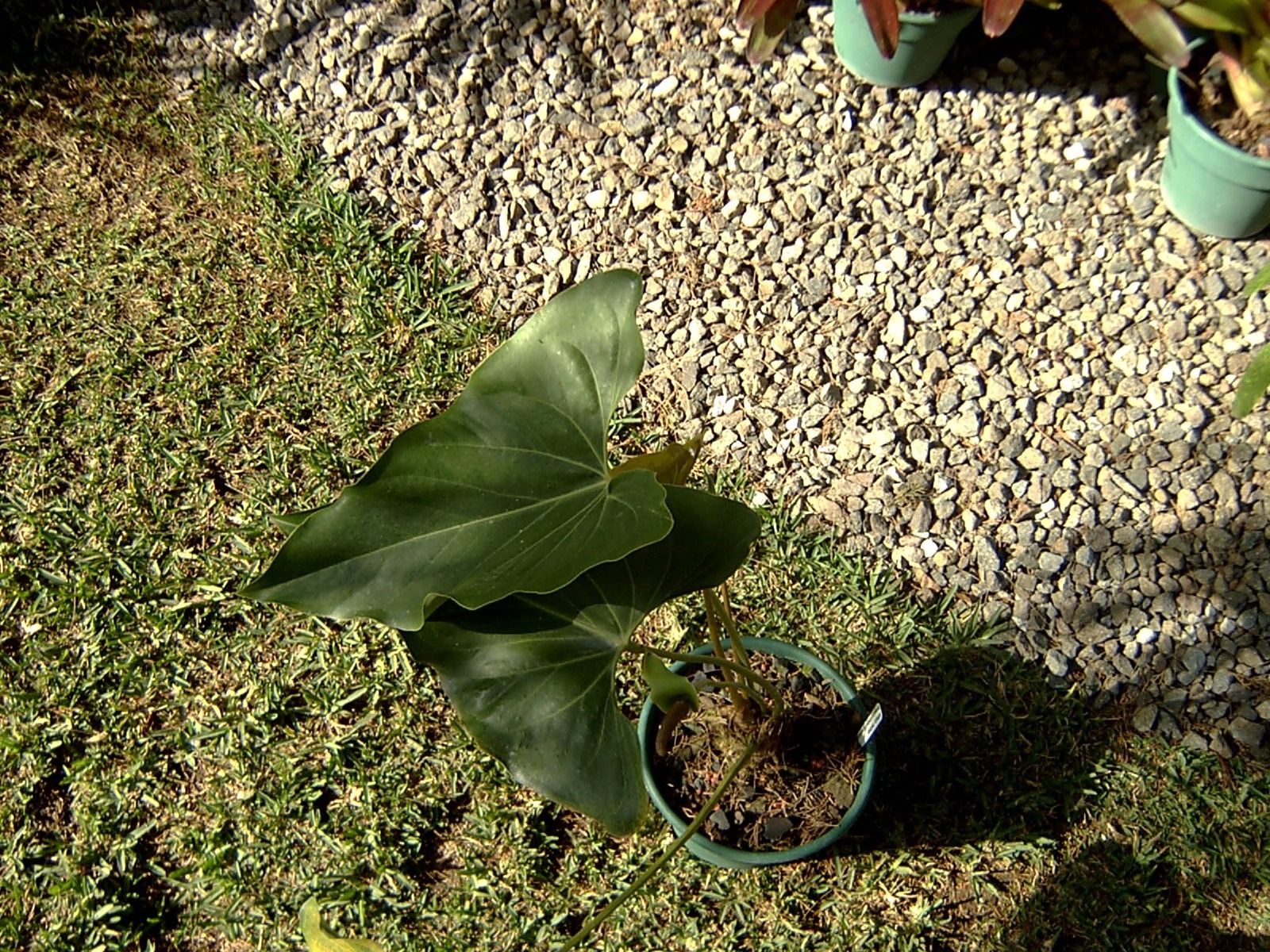
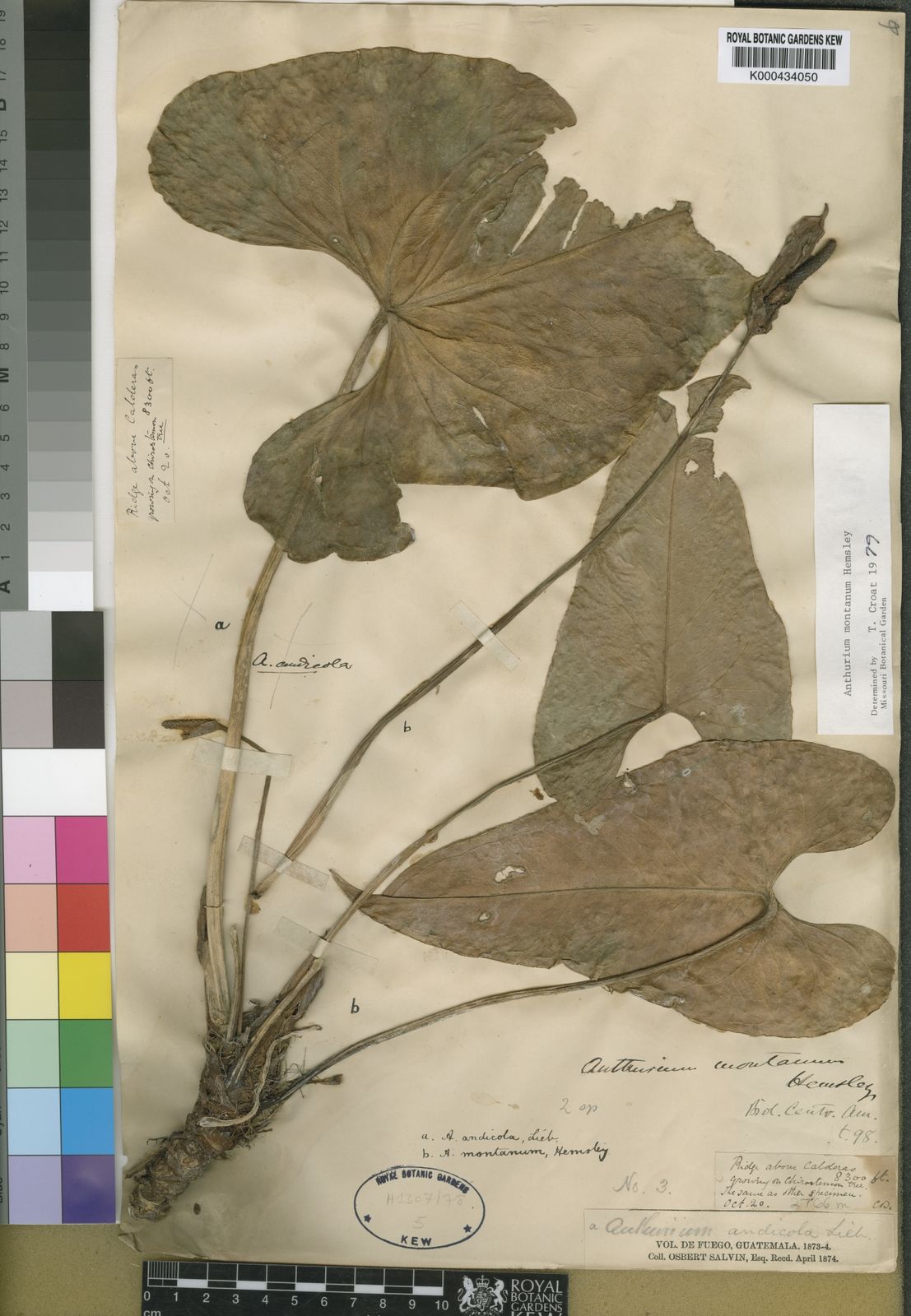
Usually epiphytic, stems 5-15 cm long, 2.5 cm diam.; leaf scars 2.5 cm wide; roots numerous, thick, descending; cataphylls coriaceous. 12 cm long, rounded at apex with subapical apiculum, ca. 3 mm long, drying reddish-brown (B & K Yellow-red 5/7.5) usually persisting as fibers around stem. LEAVES with petioles spreading to erect, (6.5)22-75(99) cm long, 5-15 mm diam., usually D-shaped, sometimes subterete, broadly sulcate, the margins acute; geniculum 1.5-3 cm long (sometimes tinged with red in larger plants); blades triangular to ovate, subcoriaceous, gradually to abruptly acuminate at apex, broadly to deeply lobed at base, 12-55 cm long, 7-30 cm wide, broadest at base; the anterior lobe 11-40 cm long; posterior lobes 5.5-18.5 cm long, usually directed upward; the sinus rarely arcuate, usually hippocrepiform or spathulate, rounded at apex; the upper surface semiglossy to glossy, the lower surface semiglossy; the midrib broadly raised at base above, acutely raised to middle, sunken at apex, convexly raised below; basal veins 3-7 pairs, the fourth to seventh coalesced 1-5.5 cm, raised above and below; the posterior ribs naked, the outer margin rolled up; primary lateral veins 6-11 per side, departing the midrib at 45°-60° angle; weakly sunken above, raised below, straight to the collective vein; lesser veins sunken above, raised below; collective vein arising from the first basal vein, sunken above, raised below, 5-14 mm from margin. INFLORESCENCE spreading, shorter than or equalling leaves; peduncle 17-49(65) cm long, 3-8 mm diam., terete to weakly ribbed, shorter than petioles; spathe subcoriaceous, yellow-green to medium green, tinged with red-violet (B & K. Yellow-green 6/7.5 to 5/10), narrowly ovate to lanceolate, 6-8.5 cm long, 1.5-2.7 cm wide, broadest just above point of attachment, caudate-acuminate at apex, round to cordate at base, inserted at 90° angle on peduncle; stipe 2.5 cm long, 4 mm diam., yellow to medium green; spadix green tinged with purple, deep purple or brown, 4-20 cm long, 5-11 mm diam. at base, 4-8 mm diam. at apex; flowers rhombic to sub-4-lobed, 2.5-4.2 mm long, 2.6-4 mm wide, the sides straight to sigmoid; 5-9 flowers visible in the principal spiral, 5-6 flowers visible in the alternate spiral; tepals matte with pale punctations, minutely and densely papillate, droplets sparse; lateral tepals 1.5-2.5 mm wide, the inner margins convex to straight and turned up against pistil; pistils weakly emergent, green; stigma linear, 0.5-0.7 mm long; stamens developing promptly from the base, the full complement developed promptly, the leading stamens preceding alternates only by 2 or 3 spirals; anthers cream to tan, 0.2 mm long, 0.5 mm wide, exserted on short, transparent filaments, quickly retracting; thecae oblong-ellipsoid, slightly divaricate; pollen yellow to cream, fading to white. INFRUCTESCENCE pendent; spadix to 20 cm long, to 2 cm diam.; berries oblong to obtusely triangular, truncate and usually broadest at apex, medium orange (B & K Yellow-red 7/2.5), 10-13 mm in both directions; mesocarp firm, thick with few raphide cells; seeds 1-2, pale greenish-white, weakly flattened, ± reniform, 5-7.5 mm long, 4-6 mm wide, 3-4 mm thick, minutely appendaged at both ends.
Habitat
Wet mountain forests and cloud forests (not designated as part of the Holdridge Life Zone system). In Chiapas the species is known principally from "bosque de oyamel" but probably also "bosque pinoencino."
Distribution
Known from Chiapas in Mexico, southwest Guatemala and western Colombia.
[CATE]

Sources

  • Angiosperm Extinction Risk Predictions v1

    • Angiosperm Threat Predictions
    • http://creativecommons.org/licenses/by/4.0
  • CATE Araceae

    • Haigh, A., Clark, B., Reynolds, L., Mayo, S.J., Croat, T.B., Lay, L., Boyce, P.C., Mora, M., Bogner, J., Sellaro, M., Wong, S.Y., Kostelac, C., Grayum, M.H., Keating, R.C., Ruckert, G., Naylor, M.F. and Hay, A., CATE Araceae, 17 Dec 2011.
    • http://creativecommons.org/licenses/by-nc-sa/3.0
  • Herbarium Catalogue Specimens

    • Digital Image © Board of Trustees, RBG Kew http://creativecommons.org/licenses/by/3.0/
  • Kew Backbone Distributions

    • The International Plant Names Index and World Checklist of Vascular Plants 2026. Published on the Internet at http://www.ipni.org and https://powo.science.kew.org/
    • © Copyright 2023 World Checklist of Vascular Plants. http://creativecommons.org/licenses/by/3.0
  • Kew Names and Taxonomic Backbone

    • The International Plant Names Index and World Checklist of Vascular Plants 2026. Published on the Internet at http://www.ipni.org and https://powo.science.kew.org/
    • © Copyright 2023 International Plant Names Index and World Checklist of Vascular Plants. http://creativecommons.org/licenses/by/3.0
  • Kew Science Photographs

    • Copyright applied to individual images